Login
Login


admin | 22nd Jul, 2026
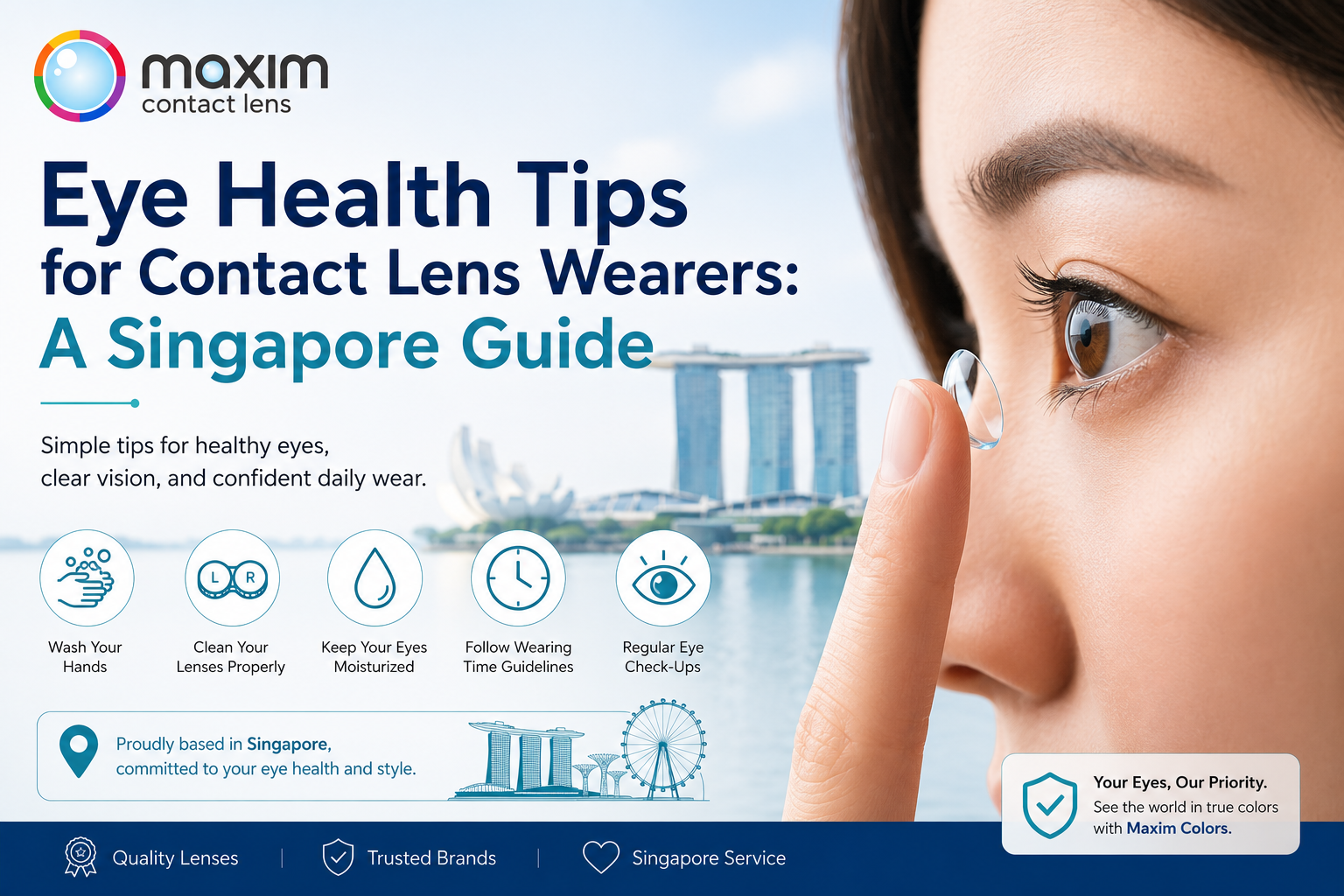
Eye Health Tips for Contact Lens Wearers: A Singapore Guide
Maxim Colors is a Singapore contact lens brand that has supplied Korean-inspired daily and monthly coloured contact lenses since 2009. Whether you already wear the best comfort contact lens Singapore has to offer or you’re still comparing options, good eye health habits matter more for your long-term comfort than which box you buy. Small daily habits — how you wash your hands, how long you wear a lens, how often you take a screen break — do more for your eyes than any single product feature. Here are seven eye care habits worth building into your routine, backed by data from health authorities.
1. Wash and Dry Your Hands Before Every Lens Handling
Washing and thoroughly drying your hands before touching your contact lenses is the single most effective habit for preventing contact lens–related eye infections. Wet or unwashed hands transfer bacteria, lint, and cosmetic residue directly onto the lens surface, and this is why the FDA lists hand hygiene as its first general safety tip for contact lens wearers.
The order matters too: put your lenses in before applying makeup, and take them out before removing it, so cosmetic particles never sit directly on the lens surface. Maxim Colors’ Wear and Care guide walks through the full insertion and removal routine step by step.
2. Follow Your Lens Replacement Schedule — Don’t Stretch It
Wearing or storing lenses longer than the schedule printed on the box is one of the most common risk behaviours reported by contact lens wearers, and it raises infection risk regardless of brand. Whether your box says daily, fortnightly, or monthly, that number is a maximum, not a suggestion.
The CDC’s 2016 national survey found that 52.4% of young adult wearers and 44.5% of older adult wearers replace their lenses at intervals longer than prescribed. Here’s how Maxim Colors’ own ranges break down, as a reference point:
Lens Type Recommended Replacement Maxim Colors Example Daily disposable Every single day, no cleaning required Maxim Colors 1 Day Elegant (30 lenses/box) Monthly coloured lens Every 30 days after opening Maxim Big and Colour Eyes Blue Box (2 lenses/box) Toric (astigmatism) monthly lens Every 30 days after opening Maxim Colour with Astigmatism Toric Box Lens case Every 3 months, regardless of lens type CDC / FDA recommendation A subscription plan removes the guesswork by sending a fresh pair on schedule, so there’s less temptation to stretch a lens past its replacement date while waiting for a reorder.
3. Give Your Eyes Regular Breaks From Screens
Contact lens wearers who spend hours on screens blink less often, which speeds up tear evaporation and can leave lenses feeling dry by the afternoon. The American Academy of Ophthalmology recommends the 20-20-20 rule: every 20 minutes, look at something 20 feet away for 20 seconds to reset your blink rate and rehydrate the eye’s surface.
Computer Vision Syndrome, also called digital eye strain, is a group of eye and vision symptoms — including dryness, redness, blurred vision, and headaches — caused by prolonged screen use, and it tends to affect contact lens wearers more noticeably because a lens on the eye already reduces natural tear film stability.
Lens material plays a role here too. Maxim Colors’ guide to silicone hydrogel vs hydrogel comfort explains which material holds up better across a long screen-heavy workday, and their notes on choosing lenses for dry, air-conditioned office days cover what to look for if dryness is a recurring problem.
4. Replace Your Lens Case Every 3 Months, Even If It Looks Fine
A contact lens case can harbour bacterial biofilm within weeks of regular use, even if it still looks clean, which is why the CDC and FDA both recommend replacing the case every three months regardless of lens type. Rinsing lenses in tap water or “topping off” old solution instead of using fresh solution each time are both linked to a higher rate of eye infections.
The same CDC survey found that 19.1% of young adult wearers and 11.0% of older adult wearers admitted to topping off solution rather than replacing it, and that 2.3%–9.5% of wearers stored their lenses directly in tap water — a habit that introduces microorganisms tap water isn’t filtered to remove for eye contact.
5. Never Sleep or Nap in Standard Contact Lenses
Sleeping in daily or monthly disposable lenses, including all of Maxim Colors’ coloured lens ranges, meaningfully raises the risk of corneal infection because closed eyelids cut off much of the oxygen the cornea needs. This applies even to short naps, not just a full night’s sleep.
Around a third of contact lens wearers (29.8%–33.3% depending on age group, per the same CDC data) report sleeping or napping in their lenses at least occasionally. Building a habit of removing lenses the moment you feel tired, rather than “just this once,” is one of the simplest ways to avoid becoming part of that statistic.
6. Get an Annual Eye Check, Even If Your Vision Feels Fine
An annual eye check catches early signs of dryness, deposits, or corneal changes long before they become uncomfortable enough to notice on your own, and it’s also when your prescription and lens fit get reconfirmed. Skipping this appointment is one of the most common gaps in contact lens hygiene.
CDC data shows 43.9% of adolescent wearers, 24.0% of young adults, and 29.6% of older adults had not visited an eye doctor at least annually. In Singapore, an eye care practitioner also needs to confirm your base curve, diameter, and prescription before you can buy coloured lenses, since even purely cosmetic “plano” lenses require a proper fitting.
7. Choose a Lens Built for Comfort, Not Just Colour
Lens design affects how your eyes hold up across a full day, on top of whatever hygiene habits you follow, so it’s worth knowing what’s actually in the lens you’re wearing. Maxim Colors’ lenses use a polished edge over 20% thinner than standard, are moulded and lathe-cut for a smoother surface, and include built-in UV protection to reduce light-related eye irritation.
Maxim Colors also uses a colour-lock system between the lens layers, so pigment stays sealed away from direct contact with the eye rather than sitting on the surface. Combined with the habits above, browsing Maxim Colors’ full range of daily and monthly comfort lenses is a reasonable next step if your current lenses aren’t holding up through a full day.
6. FAQ Section
How often should I replace my contact lens case?
Replace your lens case every 3 months regardless of what type of lens you wear, even if it still looks clean. Bacterial biofilm can build up inside a case well before it becomes visibly dirty.
Can I use tap water to rinse my contact lenses?
No. Tap water is safe to drink but is not sterile, and it can carry microorganisms that contaminate lenses and lens cases. Always use fresh contact lens solution for rinsing, cleaning, and storage.
Is it normal for my eyes to feel dry by the end of the day?
Mild dryness by late afternoon is common, especially in air-conditioned offices or after long screen sessions, but it shouldn’t be ignored. Preservative-free lubricating drops and regular screen breaks help, and persistent dryness is worth mentioning at your next eye check.
Do coloured contact lenses need the same eye care as clear lenses?
Yes. Coloured and cosmetic lenses sit on the eye exactly like clear vision-correction lenses, so the same hand hygiene, replacement schedule, and no-sleeping rules all apply. A prescription and fitting are required even for lenses with no vision correction.
How often should I have my eyes checked if I wear contact lenses?
At least once a year, even if your vision and comfort feel fine. Annual checks confirm your prescription, lens fit, and base curve are still correct, and catch early signs of dryness or corneal changes.
Can I wear makeup with contact lenses in?
Yes, but the order matters: insert your lenses before applying makeup, and remove your lenses before taking makeup off. This keeps cosmetic particles and remover chemicals from coming into direct contact with the lens surface.